
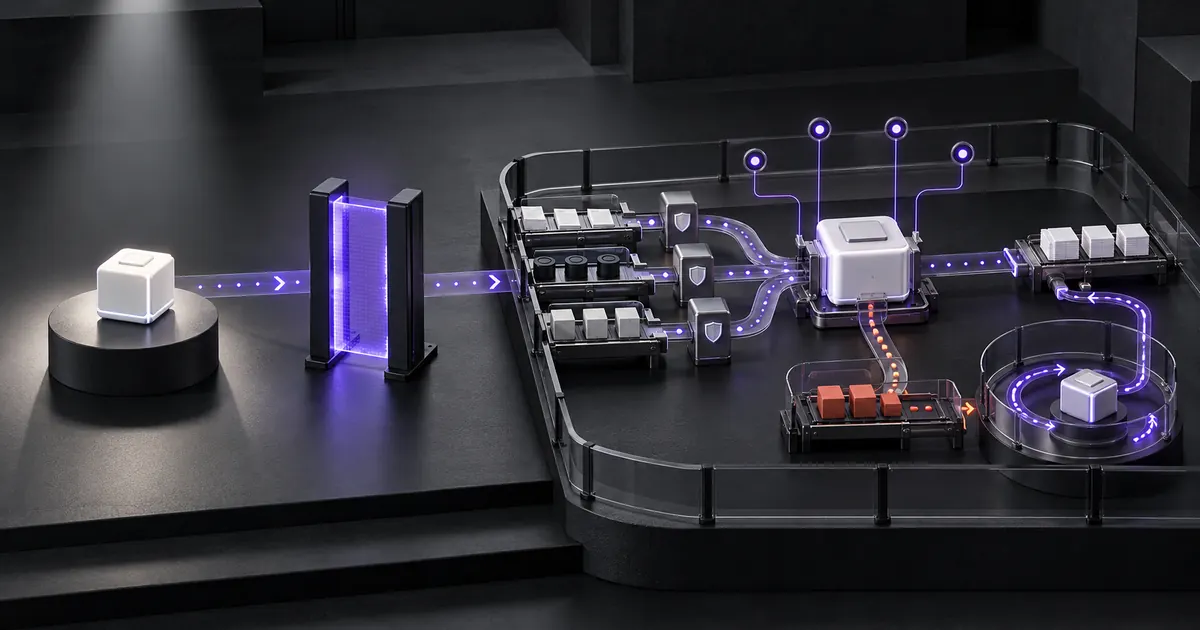
What is the difference between an AI demo and a production system?
An AI demo shows that a capability can work under the conditions presented. A production system must keep producing an acceptable business result across real inputs, users, dependencies, failures, and changes. Zyphh's workflow-first operating approach treats the model as one component inside that larger system.
The demo still matters. It can test feasibility, user comprehension, and whether the workflow deserves more investment. The mistake is using a successful walkthrough as evidence for reliability, security, scale, ownership, or business impact. Those claims need different tests.
How does an AI demo compare with a production system?
The practical difference is the burden of proof. A demo asks whether a selected path can succeed. Production asks whether the full workflow remains useful, controlled, observable, and recoverable when conditions stop being ideal. NIST's 2026 report on monitoring deployed AI systems explains that pre-deployment evaluations occur mainly in controlled settings, while post-deployment monitoring is needed to see real-world reliability, unforeseen outputs, and unexpected consequences.
| Evidence area | What a demo may show | What production must show |
|---|---|---|
| Objective | One scenario produces a useful-looking result | A named outcome has an owner, threshold, and review rule |
| Inputs | Curated examples fit the expected format | Representative, incomplete, stale, conflicting, and hostile inputs have defined handling |
| Integration | A test connection completes the happy path | Retries, duplicates, timeouts, partial writes, and downstream confirmation are controlled |
| Authority | The tool can perform an action | Each identity has the minimum permission and consequential actions require approval |
| Quality | Stakeholders like a small output sample | Task-specific evals have pass criteria, failure slices, and a change-triggered regression set |
| Operations | A builder can explain what happened | Operators can trace, alert, pause, repair, and safely resume the workflow |
| Economics | One run has acceptable speed and cost | Volume, latency, usage cost, review work, support, and incident cost fit the business case |
| Change | The staged version works today | Model, prompt, policy, schema, connector, and data changes trigger controlled review |
What does a successful AI demo actually prove?
A good demo can prove feasibility, expose an unusable interaction, and identify the next assumption worth testing. That is valuable evidence. It should end with a narrower question, such as whether the classifier can route representative support requests or whether a draft can save reviewer time without hiding important context.
A demo does not prove generalization. Inputs may be selected, test permissions broad, and failures quietly repaired between runs. A generated CRM summary is not useful if it attaches to the wrong account, duplicates a task, or overwrites a field Finance relies on.
Record exactly what the demo established: the version shown, data used, supported path, observed failure, and unresolved assumption. This keeps the prototype from becoming an undocumented promise. If the next decision depends on performance, test performance. If it depends on adoption, put the workflow in front of the people who will operate it.
What evidence makes an AI system production-ready?
Production readiness is evidence that the whole operating path meets its stated acceptance rules. NIST's AI Risk Management Framework Core calls for intended-purpose limits, representative testing, human oversight, production monitoring, safe failure, recovery, change management, and accountable roles across the lifecycle. The threshold should rise with the consequence of a wrong action.
Start with task-specific evaluation. OpenAI's current evaluation guidance recommends objectives, representative data, explicit metrics, comparisons, and continuous evaluation. It also warns against vibe-based evaluation and datasets that do not reproduce production traffic. A pass rate without the failed cases, sample definition, and business consequence is weak evidence.
Then constrain authority. OWASP's Excessive Agency guidance recommends minimum tool functionality, minimum downstream permissions, authorization outside the model, and human approval for high-impact actions. A model instruction is not an access control. Production needs enforced boundaries around what the system can read, change, send, or delete.
How should a team test the path from demo to production?
Use a proof ladder that adds real conditions and authority one stage at a time. Each stage should have an entry rule, a pass rule, a stop rule, and an owner. Moving slowly through a vague pilot is not safer than moving quickly through explicit gates.
- Offline replay: run historical and human-curated cases through the full decision path. Include normal, edge, adversarial, and prohibited cases. Score the final business result, not only the model response.
- Sandbox integration: connect realistic schemas and test identities. Force rate limits, timeouts, expired credentials, duplicates, malformed responses, and partial downstream failures.
- Shadow mode: process live inputs without changing the system of record. Compare proposals with actual decisions and capture disagreements by failure type.
- Approval-gated use: let the system prepare a real action, but require a named person to review the evidence, destination, and consequence before execution.
- Bounded production writes: allow one narrow, reversible action for an agreed slice of traffic. Monitor the business outcome, exceptions, cost, latency, and manual correction load.
- Staged expansion: widen traffic, permissions, or use cases only after the current stage meets its acceptance rules. Re-run the relevant regression set after a material change.
Do not treat shadow agreement as proof that a write path is safe. It does not exercise approval delay, permission failures, duplicate protection, rollback, or the human behavior that appears once staff depend on the system.
What should be in a production-readiness evidence packet?
A useful evidence packet lets a buyer, operator, security reviewer, and workflow owner inspect the same system without relying on the demo presenter. The checklist below is an editorial synthesis of the cited guidance. It is not a formal standard or certification.
| Artifact | Question it must answer | Weak substitute |
|---|---|---|
| Workflow contract | What trigger, finish, data, tools, users, actions, and exclusions are approved? | A broad use-case slide |
| Eval report | Which representative cases passed, failed, or remain uncertain against named criteria? | A handful of impressive outputs |
| End-to-end trace | Can an operator reconstruct the input, version, tool call, approval, write, response, and correction? | Model logs without downstream state |
| Permission map | Which identity can access each field, tool, record, and environment? | A promise that the prompt limits behavior |
| Failure rehearsal | What happens during timeout, bad data, duplicate delivery, partial write, or prohibited action? | A generic error message |
| Operating runbook | Who receives alerts, pauses work, repairs records, approves changes, and covers absences? | The builder is available if needed |
| Economics record | Do real volume, review time, usage, latency, and support cost preserve the business case? | Model cost per call alone |
| Change register | Which versions are live, what changed, and which tests or approvals ran again? | An unversioned prompt document |
When should a demo move forward, be narrowed, or stop?
Move forward when the next stage tests one material unknown and the failure is contained. Narrow the scope when the outcome is useful but the data, permissions, recovery path, or owner cannot support the proposed autonomy. Stop when the team cannot verify the final state, accept the downside, or assign responsibility for exceptions.
No universal score makes an AI system production-ready. NIST's 2026 monitoring report says methods and common terminology are still developing. That uncertainty is a reason to make evidence local and explicit, not a reason to skip monitoring. The team should be able to state what acceptable means for this workflow and what new evidence would reverse the decision.
Before granting real write access, use the AI automation guardrails guide to define permissions, approvals, logs, stop rules, and recovery beside the actions they control. Bring the resulting evidence packet to the launch decision. A credible outcome may still be a smaller workflow, a longer shadow period, ordinary software without AI, or no deployment.
Turn this into your own build plan.
Run the Workflow Opportunity Score or book a strategy call. Bring one repeated workflow, the tools involved, and the number that should move.
Run the scoreSources and further reading
FAQ
Does production-ready AI mean the model reached a certain accuracy score?
No. A model score can support one acceptance rule, but production readiness also covers representative inputs, integration behavior, permissions, human oversight, monitoring, recovery, cost, and ownership. The right threshold depends on the task and the consequence of error.
Can the same code from an AI demo go into production?
Sometimes, but reusing code does not transfer the demo's assumptions into proof. The team still has to validate configuration, identities, data handling, dependencies, retries, duplicate protection, logs, alerts, recovery, and support under the production environment.
How long does it take to move an AI demo into production?
There is no credible universal timeline. A narrow read-only workflow with known data and an owner may move quickly. A system that changes customer records, sends external messages, or makes consequential decisions needs more evaluation, review, failure testing, and staged exposure.
What is the minimum evidence to request after a vendor demo?
Ask for the intended-use boundary, representative eval method and results, one end-to-end trace, one observed failure and recovery, the permission model, operating owner, and change process. If a consequential claim has no inspectable evidence, treat it as an assumption.