
What are AI automation guardrails?
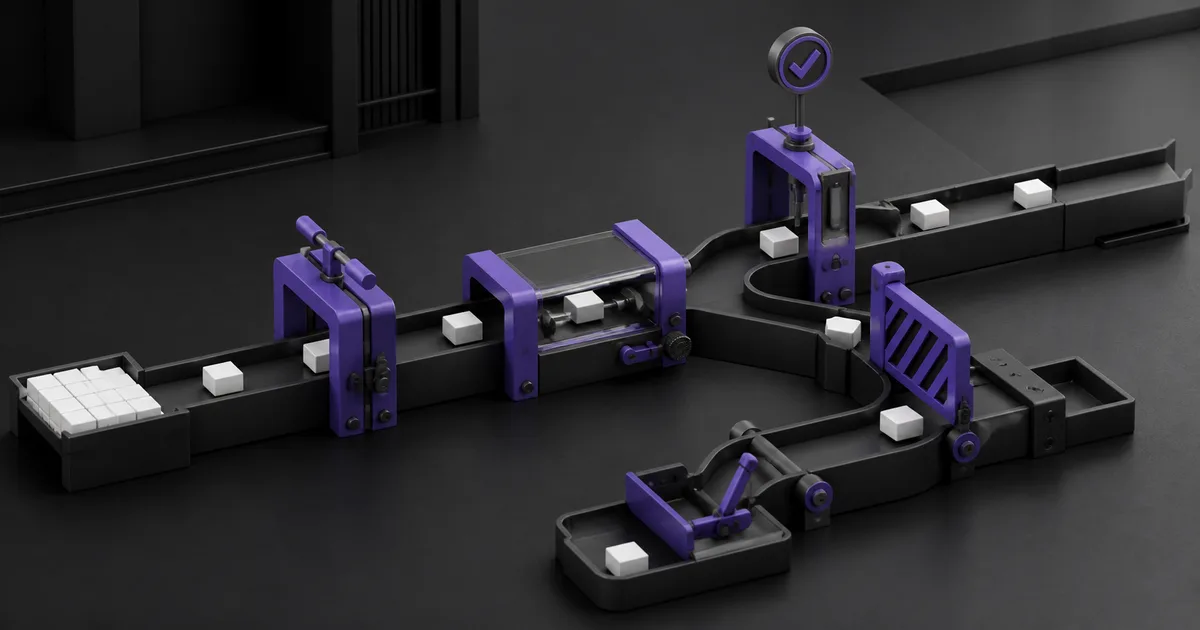
AI automation guardrails are enforced controls that limit what a workflow may read, decide, change, and send, then make significant actions visible and recoverable. They are not a prompt asking a model to be careful. Zyphh's workflow-first operating principles group the practical controls as permissions, logs, approvals, alerts, and rollback paths.
No credible universal evidence supports the premise that most AI automations fail within 90 days. The useful question is whether a specific workflow can detect a bad input, block an unsafe action, expose a partial failure, and recover without guessing. This guide turns that test into an operating framework for B2B SaaS teams.
Why does an automation become unreliable after launch?
An automation becomes unreliable when its operating context changes faster than its controls. A prompt can stay identical while CRM fields, permissions, policies, source documents, APIs, model behavior, or ownership rules change around it. The run can look healthy while the business result is wrong.
NIST's AI Risk Management Framework Core treats risk management as continuous lifecycle work. It calls for defined human oversight, production monitoring, safe failure, recovery, deactivation, and change management. That is why launch approval alone is weak evidence. A durable system needs controls before, during, and after each action.
Which guardrails belong in a production control stack?
A production control stack needs six layers: scope, access, validation, approval, observation, and recovery. Each layer should make a decision that code or a named person can enforce. A policy document is useful, but it is not a runtime control until the workflow can block, pause, isolate, alert, or reverse work.
| Layer | Decision to define | Evidence to keep | Failure response |
|---|---|---|---|
| Scope | Allowed trigger, finish, tools, records, and prohibited actions | Workflow and policy version | Reject work outside the contract |
| Access | Minimum identity, permission, field, and environment needed | Caller, credential reference, and granted scope | Deny the action and alert the owner |
| Validation | Required inputs, allowed values, evidence rules, and output shape | Source references, rule version, and result | Quarantine the record for review |
| Approval | Which actions need a person, and what that person must see | Proposal, evidence, decision, approver, and time | Pause, reject, or resume the exact action |
| Observation | Events, thresholds, exceptions, and alerts that show workflow health | Linked action, tool, response, retry, and override records | Investigate or trip a stop rule |
| Recovery | Duplicate protection, undo path, repair owner, and deactivation plan | Action IDs, snapshots, release version, and repair result | Roll back, compensate, isolate, or shut down |
OWASP's Excessive Agency guidance reaches a similar design rule from a security angle: minimize tool functionality, permissions, and autonomy, then require human approval for high-impact actions. The narrowest useful capability is easier to test and limits the damage when a failure slips through.
Where should human approval sit?
Human approval should sit immediately before an action whose consequence exceeds the workflow's tested authority. Do not place a generic review at the end of a long run after emails, payments, access changes, or customer-record updates have already happened. The approval must bind to the exact proposal, evidence, tool, arguments, and policy version.
- Allow automatic execution for bounded, reversible work with validated inputs and a tested recovery path.
- Route uncertain, incomplete, conflicting, or out-of-distribution cases to an exception owner.
- Require approval for consequential external communication, money movement, permission changes, destructive actions, or policy exceptions.
- Block capabilities that the workflow does not need or that the organization cannot observe and recover.
OpenAI's human-in-the-loop documentation shows one sound runtime pattern: pause a specific tool call, preserve state, approve or reject it, then resume the same run. Product features differ, but the operating requirement is stable. An approver needs enough context to make a real decision, not an unexplained approve button.
What should an AI automation audit log record?
An audit log should reconstruct what triggered the workflow, which evidence and version informed the decision, what was proposed, who approved it, what executed, and how the downstream system responded. CISA's logging guidance recommends recording relevant activity, centralizing logs, monitoring high-risk events, protecting log access, and assigning incident roles.
- Use one correlation ID across the source event, model or rule decision, tool call, approval, write, retry, and repair.
- Record model, prompt, policy, schema, workflow, connector, and release versions when they affect the result.
- Keep source references and decision facts, while redacting secrets and avoiding unnecessary copies of customer data.
- Separate proposed, approved, executed, rejected, and manually corrected states so a dashboard cannot blur them into success.
Logs are also sensitive data. Set access and retention rules, protect them from alteration, and test whether an operator can trace one failed record without opening several unrelated systems.
How do stop rules and recovery controls work?
Stop rules prevent repeated damage; recovery controls repair the work already attempted. A circuit breaker should halt the affected path when a prohibited action, repeated dependency failure, unexplained output shift, or loss of required evidence crosses the team's stated threshold. The fallback can queue work, return it to manual handling, or disable one capability without taking down the whole operation.
Recovery depends on the action. Use idempotency keys to prevent duplicate writes, snapshots or version history when state can be restored, compensating actions when a direct undo is impossible, and an exception queue when a person must repair the record. NIST's framework specifically includes response, recovery, override, incident handling, and deactivation. A recovery plan that has never been rehearsed is still an assumption.
What should the team test before allowing production writes?
Before production writes, test the workflow as an operating system rather than a model demo. OpenAI's guardrail documentation notes that input, output, and tool controls run at different boundaries. Put the check beside the side effect it must prevent, and use a blocking path when work must not begin before validation.
- Write the action contract: allowed inputs, evidence, outputs, tools, records, owners, stop conditions, and prohibited behavior.
- Inventory every service identity and remove tools, fields, records, and environments the workflow does not need.
- Test normal cases plus missing fields, stale evidence, conflicting instructions, hostile content, and unfamiliar formats.
- Force timeouts, rate limits, expired credentials, unavailable APIs, and partial downstream writes.
- Replay the same event to prove duplicate protection, then change the policy or schema to test version handling.
- Rehearse approval, rejection, escalation, stop, rollback, compensation, manual repair, and deactivation with the named owner.
- Run in shadow or draft-only mode until the evidence supports the planned level of autonomy.
How should a SaaS team operate guardrails after launch?
Operate guardrails through ownership and change triggers, not a set-and-forget calendar. Review representative accepted, rejected, escalated, retried, and manually corrected cases. Re-run the regression set when the model, prompt, tool, schema, source data, permission, policy, or downstream system changes.
The owner should know the intended business finish, acceptable residual risk, alert path, repair procedure, and authority to pause the workflow. If the team cannot answer those points, narrow the automation until it can. A small observable path is more useful than broad autonomy that nobody can explain.
If a pilot already lacks these controls, use the failed AI pilot recovery guide to separate recoverable build work from sunk cost before adding more features. The next decision should be concrete: keep the current autonomy, reduce it, or stop the workflow until the missing evidence exists.
Turn this into your own build plan.
Run the Workflow Opportunity Score or book a strategy call. Bring one repeated workflow, the tools involved, and the number that should move.
Run the scoreSources and further reading
FAQ
Are prompt instructions enough to guard an AI automation?
No. Prompts can guide behavior, but permissions, validation, approvals, stop rules, logs, and recovery need enforcement outside the model. Put each control beside the action or boundary it governs.
Does every AI action need human approval?
No. Bounded and reversible actions can run automatically after validation when their failure cost is acceptable and recovery is tested. Require approval where an action is consequential, ambiguous, destructive, externally visible, or outside the workflow's normal policy.
Do most AI automations fail within 90 days?
No authoritative universal dataset supports that claim. Reliability depends on the workflow, integrations, controls, ownership, and definition of failure. Measure the deployed system against its own task, safety, recovery, and business thresholds.
What is the difference between a guardrail and monitoring?
A guardrail can constrain, block, pause, or redirect an action. Monitoring observes events and alerts an owner. A production workflow usually needs both because detection without a response path leaves the team watching a failure continue.