
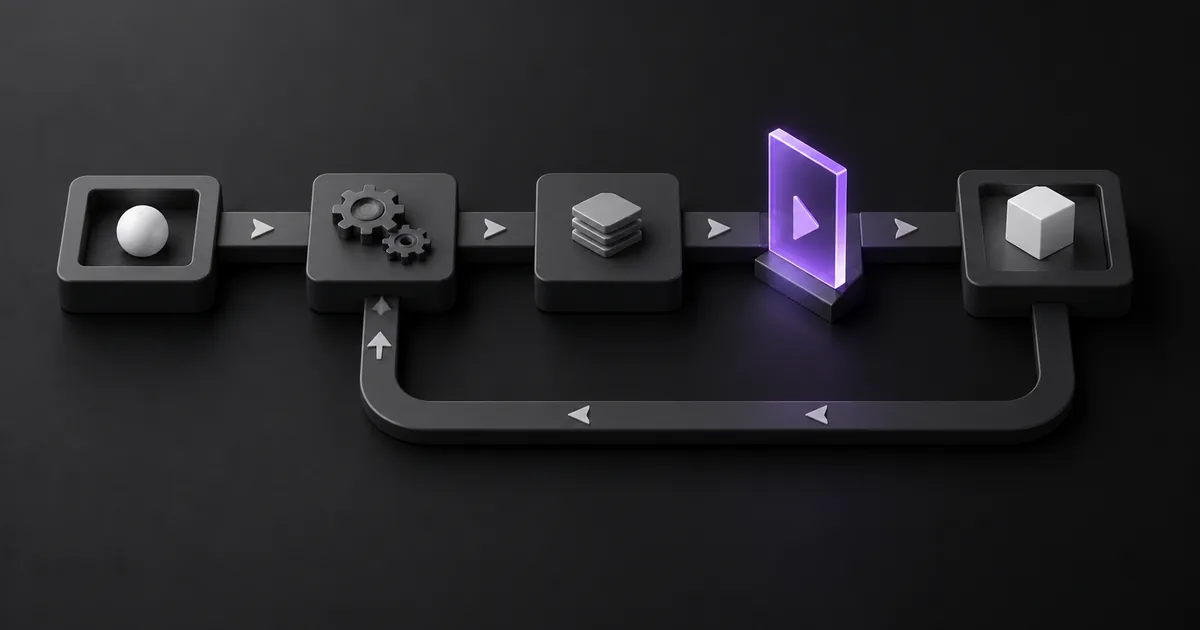
What makes AI agent workflow design reliable?
Reliable AI agent workflow design turns a vague goal into bounded states, permitted decisions, narrow tools, and verifiable exit conditions. The prompt matters, but it cannot enforce identity, permissions, durable state, or recovery. Those controls belong in the surrounding application.
OpenAI's practical guide to building agents describes an agent as a model, tools, and instructions operating in a loop until an exit condition is reached. A production design needs to specify that loop before implementation. Zyphh's workflow-first approach starts with the operating decision and evidence of completion, not the agent framework.
What should the task contract define first?
The task contract should name one job, its owner, allowed inputs, trusted sources, output, authority, and failure route. If the team cannot agree on those fields, an agent will inherit the ambiguity and make it harder to see who owns the result.
- Trigger: the event that creates a run and the required input fields.
- Goal: one observable business outcome, not a broad instruction to help.
- Evidence: the sources the agent may trust and how freshness is checked.
- Authority: the records it can read, draft, change, or never touch.
- Completion: the external state that proves the job finished.
- Fallback: the person or queue that owns blocked, uncertain, or failed work.
Write exclusions beside the goal. A renewal-review agent might assemble account evidence and draft a recommendation, while pricing exceptions and contract commitments remain outside its authority.
How do you map states and transitions?
Map the workflow as a small state machine. Each state needs an entry condition, allowed action, exit evidence, and owner. This exposes loops, missing approvals, and dead ends that a happy-path prompt can hide.
| State | Allowed work | Exit evidence | Failure route |
|---|---|---|---|
| Intake incomplete | Validate required fields | Required identifiers are present | Request missing data |
| Ready to research | Read approved sources | Sources and versions are recorded | Send stale or missing sources to owner |
| Proposal ready | Draft a bounded next action | Output passes schema and policy checks | Revise once or route for review |
| Awaiting approval | Pause without changing systems | Named approver accepts or rejects | Expire to review queue |
| Executing | Call one approved write tool | Target system confirms final state | Retry safely, compensate, or stop |
| Closed | Record outcome and trace | Result and owner are visible | Reopen from monitored exception |
State names should describe facts, not confidence. Ready to execute is testable. Looks good is not. Store the state outside the model so a retry or new session does not erase it.
Where should the model make decisions?
Give the model the smallest decision surface that benefits from language judgment. Code should handle stable rules, permissions, budgets, required fields, and irreversible transitions. The model can interpret messy requests, compare evidence, choose among permitted read tools, or draft a proposal.
A useful design marks every transition as deterministic, model-directed, or human-approved. If a branch can be written as a stable rule, keep it deterministic. If the next step changes with unstructured context, let the model propose it. If the action changes money, access, contracts, customer commitments, or production data, route it through an approval rule that the model cannot bypass.
How should tools, identity, and memory be designed?
Each tool should expose one narrow capability with a clear schema, permission boundary, and result. Do not give a research task a general administrative token. Separate read tools from write tools, validate arguments again at execution time, and return explicit success or failure states.
NIST's 2026 agent identity and authorization concept paper frames identification, authentication, authorization, delegated access, logging, and data provenance as open implementation concerns for enterprise agents. That supports a practical rule: bind each run to a known agent identity, initiating user, granted scope, and recorded intent.
Memory needs the same discipline. Store only what later runs require. Separate user statements from verified facts, attach source and expiry metadata, and block retrieved content from becoming instruction without review. Keep memory no larger than the next run needs.
Which orchestration pattern fits the workflow?
Choose the simplest pattern that meets the task contract. Google Cloud's current agentic system design guidance recommends assessing task structure, latency, cost, and human involvement before choosing an architecture. Predictable work may not need an agent at all.
| Pattern | Use when | Main tradeoff |
|---|---|---|
| Single bounded agent | One loop can use a small tool set | Instructions and tools can become crowded |
| Sequential workflow | Known stages must run in order | One slow stage delays the whole path |
| Parallel workflow | Independent research or checks can run together | More cost and conflict resolution |
| Router plus specialists | Inputs fall into distinct, testable categories | Routing errors send work to the wrong path |
| Manager and workers | Subtasks cannot be predicted in advance | More latency, evaluation, and coordination work |
Start with one agent and deterministic helpers. Add another agent only when a testable boundary, tool set, or context requirement justifies the handoff.
Where do approval, stopping, and recovery belong?
Place approval immediately before the consequential transition, after the reviewer can see the proposed action and evidence. An approval at the start of a long run does not cover a later tool choice that the reviewer never saw.
The OWASP Top 10 for Agentic Applications 2026 covers goal hijacking, tool misuse, identity and privilege abuse, memory poisoning, cascading failures, and human-agent trust exploitation. Design against those failure surfaces with scoped tools, independent checks, explicit confirmations, and a hard stop for high-privilege or irreversible actions.
Set limits for turns, elapsed time, cost, retries, repeated tool calls, and unresolved ambiguity. Recovery may mean a safe retry, a compensating action, a rollback, or a handoff. The agent should never invent success because its retry budget ran out.
How do you test the complete agent trajectory?
Test the full path from trigger to verified final state. A correct final sentence can hide a wrong tool, an unnecessary data read, a missed approval, or a duplicate write. Score both the outcome and the trajectory that produced it.
Anthropic's agent evaluation guidance notes that agents act across many turns, modify their environment, and adapt after intermediate results. Build cases for normal work, missing data, conflicting evidence, unavailable tools, timeouts, prompt injection, permission denial, repeated runs, approver rejection, and failed recovery.
- Run offline cases against a controlled environment and grade final state, policy compliance, tool sequence, and trace completeness.
- Use shadow mode on representative live inputs without allowing writes.
- Release one narrow action with monitoring, a rollback path, and a named incident owner.
- Rerun the suite whenever a model, prompt, tool, source, policy, or workflow state changes.
What does an illustrative workflow blueprint look like?
Consider an illustrative renewal-review workflow. A deterministic trigger creates a run 90 days before renewal. Code validates the account, owner, contract, and data permissions. The agent gathers approved product-usage, support, and billing evidence, then drafts a risk summary with source references.
A policy checker rejects unsupported claims and missing evidence. A customer-success manager reviews the summary and proposed next step. Only after approval can a narrow tool create the internal task. The target system's returned task ID proves completion. A timeout, stale source, permission error, or rejection sends the run to an owned queue without contacting the customer.
This example does not claim a performance result. Its value is structural: the model handles interpretation while code owns state, access, approval, and proof that the action happened.
What should the pre-build review check?
A workflow is ready to build when the team can answer each question without relying on the model to fill a policy gap.
- Is the goal narrow, and is completion observable outside the conversation?
- Are states, transitions, owners, timeouts, and dead ends documented?
- Does each tool have the least authority needed and safe retry behavior?
- Are instructions separated from untrusted data and retrieved content?
- Does approval sit directly before each consequential action?
- Can logs reconstruct the trigger, evidence, decision, tool call, result, and override?
- Do evaluation cases cover attacks, outages, duplicates, and recovery?
The broader AI automation guardrails guide covers the production control stack around permissions, audit logs, stop rules, and recovery.
What is the practical next step?
Take one candidate workflow and draw six boxes: trigger, evidence, proposal, approval, action, and verified outcome. Add every failure exit before choosing a framework. Then mark which transitions belong to code, the model, or a person.
If the diagram cannot show who owns a blocked run or how completion is proved, the design is not ready. Fix that operating gap before giving the agent another tool.
Turn this into your own build plan.
Run the Workflow Opportunity Score or book a strategy call. Bring one repeated workflow, the tools involved, and the number that should move.
Run the scoreSources and further reading
- OpenAI: A practical guide to building agents
- Google Cloud Architecture Center: Choose a design pattern for your agentic AI system
- Anthropic: Demystifying evals for AI agents
- NIST NCCoE: Accelerating the Adoption of Software and AI Agent Identity and Authorization
- OWASP: Top 10 for Agentic Applications for 2026
FAQ
What is an AI agent workflow?
An AI agent workflow is the operating path around a model-directed loop: trigger, state, context, tools, decisions, approvals, stop conditions, and verified completion. The agent may choose some steps, while the application enforces stable rules and authority.
Should an AI agent workflow use one agent or several?
Start with one bounded agent and deterministic helpers. Add specialist agents only when they need distinct context, tools, evaluation criteria, or ownership. Multiple agents add handoffs, latency, cost, and more failure paths.
Where should a human approve an agent action?
Place approval directly before a consequential action, after the reviewer can inspect the proposed change and its evidence. Approval should expire or route to a queue rather than leave a run waiting without an owner.
How do you know an AI agent workflow is complete?
Use verified external state, such as a returned record ID, accepted transaction status, or confirmed handoff owner. A confident model message is not proof that the target system changed or the business task finished.