
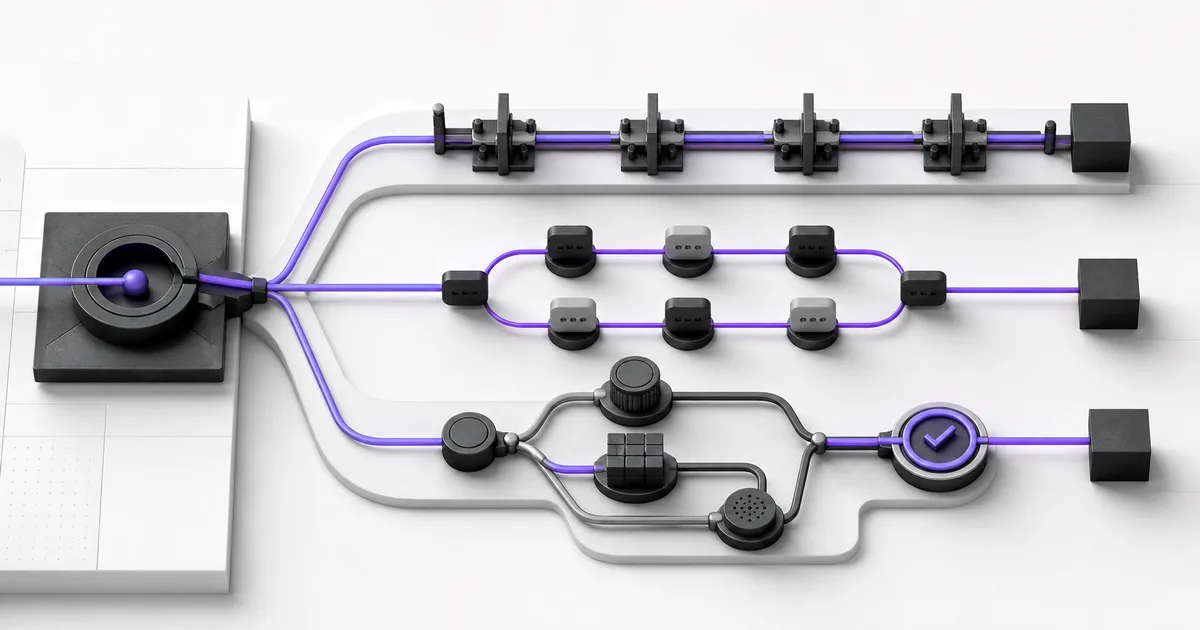
What is the difference between AI agents, chatbots, and automation?
AI agents vs automation is mainly a question of who chooses the next step. Traditional automation executes a path that people define in advance. A chatbot is software designed around conversation. An AI agent uses a model to choose steps and tools toward a goal within set limits.
These categories overlap. A chatbot can trigger a fixed workflow or provide the interface for an agent. An agent often relies on ordinary automation for reliable actions such as validating fields and writing approved changes. Zyphh's AI and automation services use the least complex pattern that can handle the workflow safely.
How do the three approaches compare?
The approaches differ most in control flow, not in how modern the interface looks. A polished chat window can sit on a fixed decision tree. A background service can be agentic if a model observes results and selects the next permitted tool.
| Decision factor | Automation | Chatbot | AI agent |
|---|---|---|---|
| Primary behavior | Executes defined steps | Exchanges messages | Pursues a goal through a bounded loop |
| Who chooses the next step? | Rules and code | Conversation flow or underlying system | Model within instructions and tool limits |
| Best input | Structured, predictable events | User questions or requests | Variable context that changes the required path |
| Typical output | A record, alert, transfer, or calculation | An answer, clarification, or handoff | A sequence of tool calls and checked results |
| Predictability | Highest when rules are stable | Depends on whether responses are scripted or generated | Lower because the path can change at runtime |
| Control burden | Input checks, retries, logs | Answer quality, scope, escalation | Tool permissions, exit conditions, approvals, evaluations, logs |
| Good fit | Routing, syncing, scheduled reporting | FAQ, intake, guided support | Tasks that require choosing among tools as context changes |
Product labels are inconsistent. Inspect the control flow and permissions before accepting terms such as assistant, copilot, bot, or agent.
What is workflow automation?
Workflow automation runs predefined steps after a trigger, such as a form submission, field change, schedule, or API event. Rules choose what happens next. The path changes only when a person updates the workflow.
Digital.gov describes robotic process automation as technology for repetitive, rules-based tasks. Common uses include data entry, reconciliation, systems integration, and automated reporting. Stable rules favor deterministic execution.
Automation can contain AI. A fixed workflow might ask a model to classify support text, then route the structured result through explicit thresholds. The model interprets one step while code controls the sequence. That is AI-assisted automation, not necessarily an agent.
What is a chatbot?
A chatbot is software that simulates conversation. The category covers menu bots, scripted question flows, generative assistants, and chat interfaces connected to business systems. Conversation describes the interface, not the system's discretion behind it.
IBM uses chatbot as the broad category for software that simulates human conversation, whether it relies on a rigid decision tree or conversational AI. Some chatbots only answer. Others call tools or expose an agent through chat.
Choose a chatbot for conversational access: answering known questions, collecting intake details, clarifying a request, or handing the user to a person. Do not add model-directed execution just to make the bot sound more capable.
What is an AI agent?
An AI agent is a system in which a model directs part of the task process. It can inspect context, choose an allowed tool, observe the result, revise its plan, and stop or ask for help. The goal stays fixed even when the route changes.
OpenAI distinguishes agents from applications that use a model without letting it control workflow execution. Anthropic describes a loop that plans, acts, observes, adjusts, and repeats until completion or a human check-in.
An agent does not need unrestricted autonomy. A business agent can have a narrow goal, short tool list, read-only access by default, turn limit, and approval before consequential writes. Those boundaries belong in the design.
Which approach fits a B2B SaaS workflow?
Choose the simplest approach that can handle the decision. Use automation for rules, a chatbot for conversation, and an agent only when the path must change with context. That flexibility has to justify added evaluation and control work.
- Can the next step be written as a stable rule? Start with automation for tasks such as field checks, territory tables, record syncing, scheduled reports, and threshold alerts.
- Is the job to answer, collect, or clarify through conversation? Start with a chatbot. Connect it to trusted content and define its handoff point.
- Must the system choose among tools after observing results? Consider a bounded agent. Define its goal, allowed actions, exit conditions, approvals, and failure route before giving it write access.
- Does the workflow contain all three needs? Build a hybrid. Keep stable transitions deterministic and limit agent discretion to the uncertain segment.
This sequence avoids paying an agent's complexity cost for a problem that code already solves. It also avoids forcing a variable task through brittle branches.
What does one workflow look like in all three designs?
Consider an illustrative support request about a billing discrepancy. Automation can validate the account ID, assign the ticket, and alert the queue owner. A chatbot can explain the billing policy, collect the invoice number, and ask a clarifying question.
A bounded agent could retrieve the account and invoice, check the policy, choose whether it needs usage data, and prepare a resolution. Fixed automations would still validate and write records. A person could approve any credit.
The uncertain step reveals the distinction. Automation follows the specified route. The chatbot manages dialogue. The agent chooses which permitted tool it needs next. A hybrid keeps predictable work testable and reserves model discretion for the variable part.
What controls change when you add an agent?
Controls should grow with the system's discretion and the consequence of its actions. Fixed automation needs validation, retries, logs, and a failure queue. A chatbot adds knowledge boundaries and escalation. An agent also needs narrow tool permissions, stop conditions, and evaluation of multi-step behavior.
NIST's AI Agent Standards Initiative focuses on secure action, interoperability, identity, and authorization. For SaaS operations, the system should have a traceable identity, use only the data and tools required for the task, and leave an audit trail.
Before expanding autonomy, test normal cases, hard exceptions, unavailable tools, ambiguous requests, and malicious instructions in retrieved content. If nobody owns a failed action or can stop the loop, the agent is not ready for broader access.
Use the custom AI agent service when a mapped workflow truly needs model-directed tool use. The design should show which steps remain deterministic, where approval is required, and how the business will judge the added discretion.
Turn this into your own build plan.
Run the Workflow Opportunity Score or book a strategy call. Bring one repeated workflow, the tools involved, and the number that should move.
Run the scoreSources and further reading
FAQ
Is every AI chatbot an AI agent?
No. A generative chatbot can produce flexible answers while a fixed application still controls every step. It becomes agentic when the model directs part of the workflow, such as selecting tools, checking results, and deciding what to do next within defined limits.
Can AI agents replace workflow automation?
Usually not. Agents rely on deterministic services for dependable actions such as validating records, enforcing permissions, calculating values, and writing approved changes. The agent is useful where the path varies. Ordinary automation should keep the stable parts predictable.
Does adding an LLM make an automation an AI agent?
No. A workflow can call a language model for classification, extraction, or drafting and still follow a fixed sequence. The architectural line is control: if code chooses every next step, it is AI-assisted automation rather than a model-directed agent.